
Reverend Marci Scott-Weis, MDIV
So, friends I want to focus on the topic of Outsiders and on God’s special concern for those on the fringes of society using Luke’s story about the table and feast and the story in Acts about the baptism of the Ethiopian Eunuch.
So, let’s start with the parable about the table and the feast. In Luke’s Gospel, Jesus practiced radical table fellowship. That meant that he ate and drank with folks that others had rejected and cast out. Everyone was welcome at his table! Jesus practiced this table fellowship with all kinds of different people—including those considered as unclean and outsiders, like tax collectors, women, Gentiles, and poor people, and that was a critical part of Jesus’ life and ministry and it meant that he broke all sorts of rules of class and religion.
No one was turned away, everyone was welcome at Jesus’ table, especially the outsiders. And in reaching out to people that others had deemed “sinners,” Jesus broke down barriers and offered fellowship. And this was so very important because in Jesus’ time, meals weren’t simply about people meeting their physical needs for food. The sharing of meals symbolized friendship and connection. If you were at someone’s table, that meant you were an integral part of someone’s community. You mattered!
And Jesus demonstrated that over and over with the stories he told about feasts and the meals that he hosted. The outsiders were the honored guests! Jesus made sure there was always a special place for those who were left out. Jesus had a special place not only at his table but in his heart for the outcast and outsider.
And Luke carries this theme of welcoming the outsider forward in the story in Acts of the baptism of the Ethiopian Eunuch. And I’m going to stop right there and unpack all of those words because they all deeply matter to this story. First off, this is the story of the first baptism of a non-Jew, a gentile in the post-Jesus world.
Second critical point here is that this person was from Ethiopia. Ethiopia was the Roman way of referring to all land south of Egypt. And the word Ethiopian in Greek literally means burnt face or blackness. So, we not only have the story of the first non-Jew being baptized here, but we also have the first person identified as Black in the New Testament.
The third really critical point we learn about this individual is that they were a eunuch. That term typically referred to boys who were castrated from a young age. And because of their features tending to be more feminine, with most having beardless faces (unusual at that time), eunuchs were seen by Romans as soft and effeminate. Which meant that eunuchs were basically seen as the sexual minorities of the ancient world.
So, in this story, Luke’s key player is a triple outsider! And the experience that this black, non-Jewish, sexual minority has in this story is going to show us something pretty remarkable about how the early church viewed outsiders.
So back to the story, our Ethiopian eunuch was on the road, and they encountered Philip, who was there because an angel told him to travel on that road. Philip and the Ethiopian eunuch have a nice bible nerd discussion and then something really remarkable and lovely happened. Our Ethiopian eunuch saw some water on the side of the road and wanted to know what was preventing them from being baptized, right then and there.
Our Ethiopian eunuch did not say to Phillip, ‘hey I know that because I am so very different from everyone in your community and I’m an outsider, there may be some hesitancy about baptizing me and fully accepting me as one of you all.’ They didn’t say that. Our Ethiopian eunuch didn’t say, ‘would you mind taking this back to your leadership and having several meetings where you debate my belovedness and vote on whether or not you all think I should be baptized and be allowed to be a part of your community.’ They didn’t say that. Instead, our Ethiopian eunuch saw the water and realized that there was nothing to stop them from being baptized.
Essentially this beautiful outsider of an Ethiopian eunuch said to Phillip, ‘I’m blessed, I’m beloved, I’m a child of God just as I am, so baptize me.’ And right then and there, recognizing their belovedness, Philip baptized them. He doesn’t hesitate; Phillip baptized the outsider, the black, sexual minority who is not a Jew. Phillip showed no concern or hesitancy about the eunuch’s gender identity, sexual orientation, faith or race (perceived or real). Instead, he acknowledged with his actions, that there was no reason to prevent the eunuch from being baptized. Phillip welcomed them without question, without conditions, without expectations, without judgement.
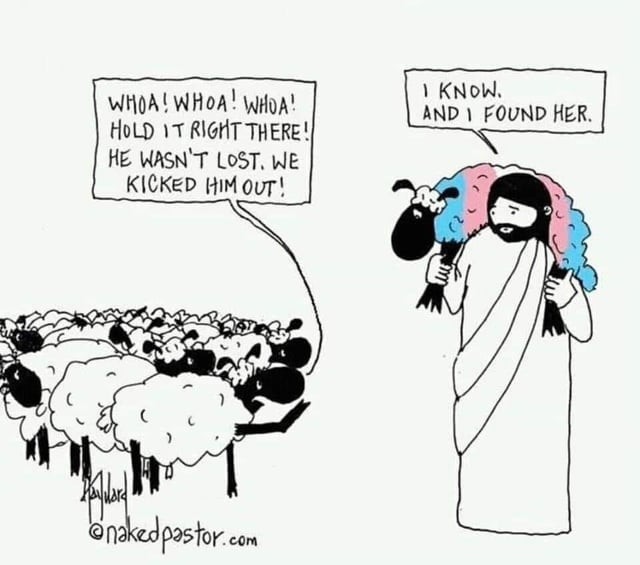
So, why does this parable of the feast and who Jesus ate meals with and the story of the Ethiopian eunuch matter? And why do they matter so much right now? Well right now in this country approximately 1 in 4 trans people in the U.S. live in states that have enacted criminal penalties related to various aspects of trans life. The number of anti-trans laws passed in the U.S. have increased sharply every year for the past five years, with over 350 laws enacted since 2021.
And why does that matter? It matters because in states that have passed restrictive laws, the likelihood of a past-year suicide attempt among 13–17-year-olds was 72% higher two years after passage compared to before the laws existed. And roughly 80% of trans adults reported that gender-affirming care bans directly negatively impacted their mental health. And it matters because in the year following the 2024 election, there was a 52% increase of assaults specifically targeting transgender individuals.
And on a personal level it matters deeply to me because my nonbinary kid recently said to me, ‘even if every problem in my life was fixed, I would still be existing in a country that wants me dead.’
So again, why does this parable about the feast and who Jesus ate with and the story of the Ethiopian eunuch matter? And why do they matter now?
They matter today in our contemporary times because as followers of Christ, we MUST be committed to developing a more Christ-like compassion for and engagement with those on the outside in our community and beyond. And in our country right now, our trans and nonbinary siblings are suffering and are in danger. They require our witness for their belovedness. They require our sanctuary for their bodies and their hearts. And they require our voices for their rights.
Well, have you heard this acronym WWJD? What would Jesus do? It’s a popular Christian saying that is intended to serve as a personal reminder to keep Jesus and his example in mind as one goes through life. You can often see it on bumper stickers or on signs at football games.
But, for most of our toughest questions, we don’t know what Jesus would do! We can’t speak with any authority about how Jesus would respond to our current debates because he didn’t say anything specifically about the vast majority of them. So instead of speculating on WWJD “what would Jesus do?” it would be way more helpful to focus on something concrete like, what did Jesus do? And maybe what did his earliest followers do in his name?
And for that, we can turn to the stories of Jesus in the Gospels and of his earliest followers in Acts, to find guidance on an issue such as the care and safety of trans and nonbinary individuals. And in particular we can look to our readings from Luke’s Gospel today and from his writings in Acts. In both, it is clear that the outsider is intended to be the honored guest not only at our tables but in our hearts. In both, it is clear that the outsider is intended to be treasured and beloved, respected and most of all welcomed, unconditionally in their belovedness.
What did Jesus do? What did Jesus’ earliest followers do? They welcomed. They accepted. They stood with and for and on behalf of the outsider. They made room at the table and in their communities and in their hearts. They provided community. They provided sanctuary.
May we find the courage to follow their example so that we may boldly accompany the outsider in our midst. May it be so…Amen
Written: June 21, 2026
